
7 Reasons Adults Over 50 On A Statin Are Switching To This French Tree Bark
(The one part of their heart they can still do something about)


INTRO: You did everything they asked. The statin. The diet. The numbers your doctor wanted.
Your cholesterol came down. The calcium score climbed anyway.
So now you brace before every scan. You read the report before the doctor even speaks.
That feeling isn't in your head, and it isn't your cholesterol. It's a layer underneath the number, and that layer has an age of its own.
You've tried the rest already. Beetroot. Fish oil. CoQ10. Nothing moved.
So why would a pine bark extract be any different? That's exactly the question to ask.
Let me say the part most pages won't. This won't dissolve the plaque you already have. Nothing does.
You wouldn't want it to. The plaque that calcifies is the stable kind. The danger is the soft plaque you can't see.
So the goal was never to chase the score down. It's to slow what forms next, on the wall going forward.
On a statin, your calcium score climbing, or it runs in the family? The plaque isn't the root, it's the symptom. Below, the 7 reasons adults over 50 are switching, starting with the root the others miss.
Target the wall behind your plaque, and the engine inside it

Your cholesterol and calcium score measure damage already done. The wall itself decides how fast new plaque forms.
A new hose bends, an old one cracks. That's your Vascular Age, the one layer you can still move.
Inside it sits an engine, eNOS, that makes the nitric oxide keeping your vessels relaxed. As the wall stiffens, that engine slows and the nitric oxide drops. It also smolders with a slow inflammation that wears it down. Same wall, two forces.
You feel it before any scan names it. Cold hands. Legs like cement by the end of the day.
📍 In a heart study of patients already on a statin, 8 weeks of this bark improved how well their arteries opened by 32% (European Heart Journal, 2012).
Proanthocyanidins reach the wall the others can't

Once I understood the wall, the supplements my patients kept bringing in all made sense. Every one of them was aiming a layer too high.
- ❌ Beetroot & the nitric oxide crowd: more fuel for an engine that's slowing because the wall is aging
- ❌ Nattokinase: works on fibrin in the blood, not the wall
- ❌ CoQ10: feeds cell energy, not the wall
- ❌ Niacin: moves a number on a lab sheet, not the wall
- ✅ The proanthocyanidins in pine bark: the one compound that works on the wall itself, the layer none of them reach
None of this is instead of your statin. Keep it.
That's why the beetroot never did much. A molecule called ADMA blocks the signal before it lands, so more nitric oxide is just more cars on a closed road. The proanthocyanidins work on the block itself.
Every bottle you tried left you where you started. You were never the problem. The layer you were aiming at was.
The first thing most people notice has nothing to do with a scan

You won't feel your arteries change. What people notice is closer to home.
Your hands stop going ice cold at the breakfast table. The knees that crack getting out of bed start to loosen up. By evening, your legs don't feel like dead weight anymore.
Often someone notices it before you do. None of it shows up on a scan yet. You just feel it first.
It works on the wall most people never notice until it's too late

But the part that matters most is the part you don't feel.
Close to 70% of heart attacks hit arteries less than half blocked.
Not the hard plaque your score measures. The soft plaque you can't see, the kind that ruptures while every number looks fine.
Heart attacks and strokes both start in the wall. Close to half of adults over 45 have it building, most without knowing.
The calcified plaque on your scan is the stable kind. The goal was never to clear the calcium. It's to slow the soft plaque forming behind it. That's the lever.
It's the pine bark backed by 39 clinical trials

That compound is most concentrated in French maritime pine bark. The bark grows in one place. Les Landes de Gascogne, a single forest on the southwest coast of France, near Bordeaux.
That bark is exactly what the research studied. 39 randomized, double-blind, placebo-controlled trials. Part of 160+ published studies over 40 years. More than 2,000 patients.
Here's what they found:
- ✅ The dilation pathway fires. The extract opened vessels in a placebo-controlled test (Hypertension Research, 2007).
- ✅ The stiff wall gives again. Arterial flexibility rose 32% in 8 weeks (European Heart Journal, 2012).
- ✅ The lining wakes up. Vessel widening rose 66% in adults with borderline numbers (International Angiology, 2015).
It works alongside everything you already take, with no side effects
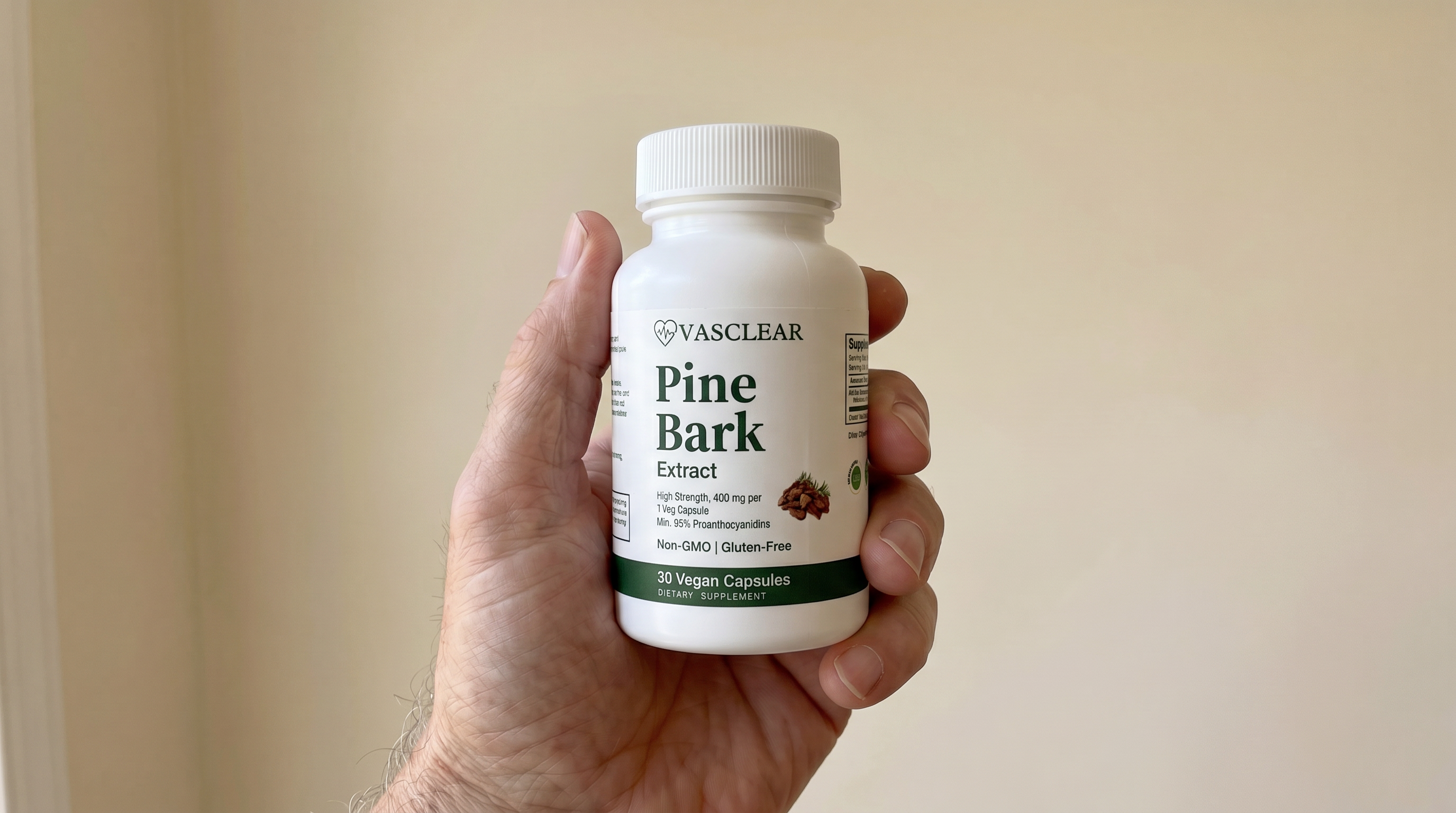
One capsule with breakfast. One ingredient, no blend, no filler.
It doesn't interfere with your statin, your blood pressure meds, or your aspirin. Whatever your cardiologist already has you on, this works alongside it.
It's also 400mg, standardized to 95% proanthocyanidins, double the 200mg used in the European Heart Journal trial.
Try it with one honest promise most pages won't make

I'll tell you what I won't tell you. This won't dissolve the plaque you already have. But the wall is the soil it grew in, and the wall is what this works on.
So here's the deal. Try it 100% risk-free for 60 days. If nothing changes, send the bottle back, even empty, for a full refund.
The upside? Walking into your next scan steadier, instead of bracing for it. That's why I recommend it.
Here's the honest part. The plaque already there doesn't come back out. What you still get a say over is the wall going forward, and how fast the next layer forms.
Picture next spring. You take the stairs without counting them. The grandkids want the park and you just go, no quiet math on your chest first. That night you notice you didn't think about your arteries once all day. You're not the next name in the family. You're the one who changed it.
The window is the wall, and it's open now.
Vasclear, French Maritime Pine Bark Extract
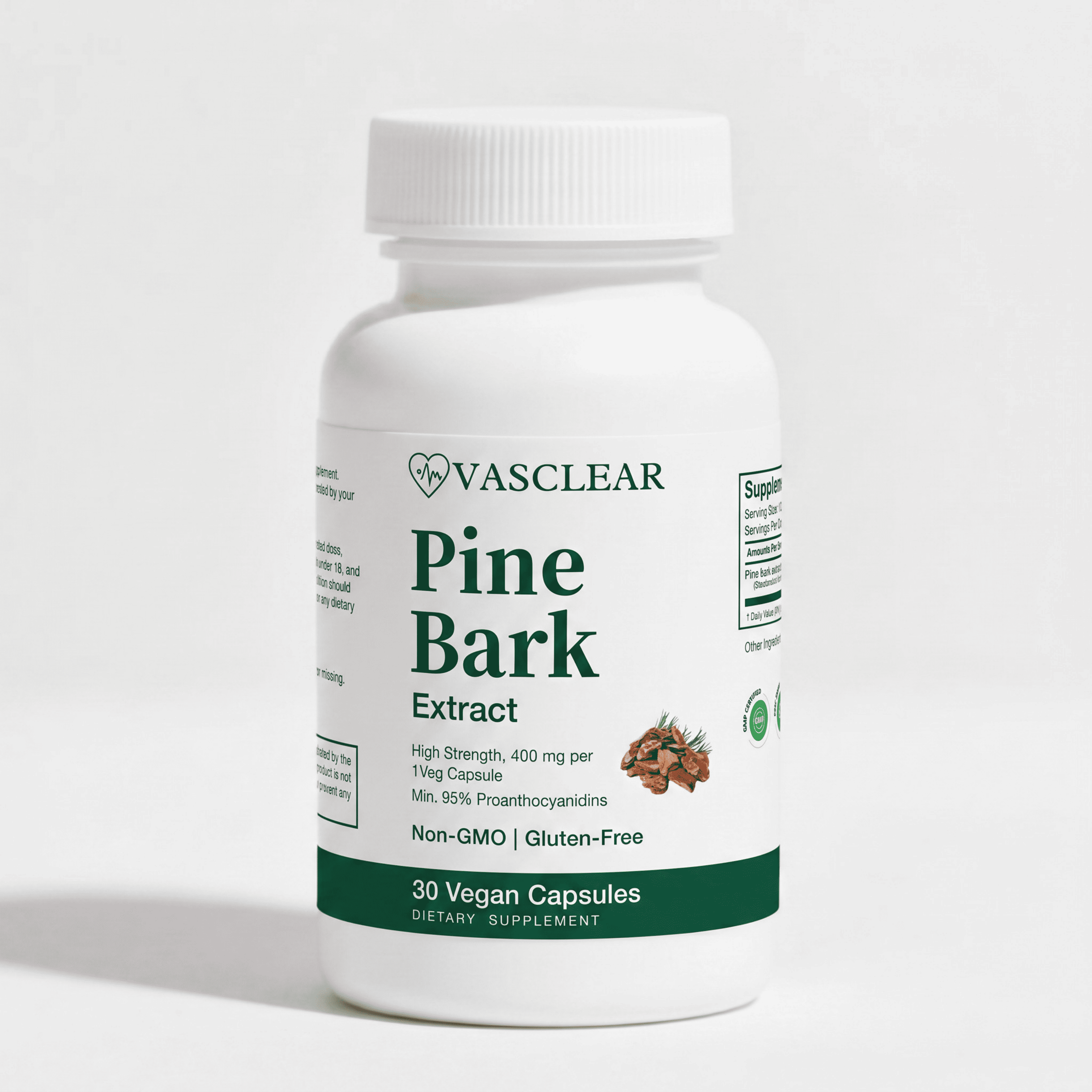
- 400mg high-potency French maritime pine bark
- 95% proanthocyanidins. The active compound that matters.
- One ingredient. No fillers. No blends.
- One of the most-studied plant extracts in the world
- Third-party tested for purity
- 60-day money-back guarantee
- Free shipping. Discreet packaging.
The first-order discount is intentional. The science shows up over months, not days, so we'd rather you start and stay long enough to feel it than buy a single bottle and quit.
Try It Risk-Free for 60 Days →What the next 90 days look like
Nothing dramatic.
You won't feel different yet, and that's normal.
The first signal.
Your hands feel warmer. Your feet stop being cold under the sheets. That's blood flow starting to return.
Energy starts to come back.
You notice afternoon fatigue is less. The stairs aren't as hard. You sleep through the night without leg cramps.
The bracing starts to ease.
What you notice most isn't a number. It's that you've stopped reading every twinge in your chest as a warning.
You feel like yourself again.
You walk into your next visit steadier, instead of bracing for it. Not just holding the line, present in your own day again.
If you don't feel a difference in 60 days, you pay nothing. No questions. Empty bottle accepted.
What other adults are saying

Still not sure? Here's why you can't just buy pine bark on Amazon.
Most pine bark on the shelf is worthless. Underdosed. Buried in 12-ingredient blends. Cheap powder that isn't standardized. You're paying for sawdust. That's why Vasclear is different.
Generic pine bark on Amazon
25-75mg per capsule. A fraction of what the research used. Often just ground-up bark, not the actual active extract. Cheap, unreliable, mostly filler.
Cardiovascular multi-blends
50mg or less of pine bark. Buried with arginine, garlic, and CoQ10. Looks impressive on the label. None of it at a dose that does anything.
Vasclear
400mg of French maritime pine bark per capsule. Double the 200mg used in the European Heart Journal trial. No filler, no stack of other ingredients trying to look impressive. Not sold in stores or on Amazon.
The questions my patients always ask
"If this works, why hasn't my cardiologist mentioned it?"
Fair question, and it isn't a conspiracy. Your cardiologist is doing his job on your cholesterol, and he should keep doing it. This is a plant extract, not a patentable drug, so no sales rep ever walks it into his office, and it isn't on the standard cardiology protocol yet. He treats the number. This works on the wall behind it.
"I've heard of pine bark before. Why would this be any different?"
Because most of it is a sprinkle. The bottles on Amazon run 25 to 75mg, a fraction of what the research used. This is 400mg standardized to 95% proanthocyanidins, double the 200mg dose in the European Heart Journal trial. Same plant, different league.
"How do I know this isn't another scam supplement?"
You don't have to take my word for it. The studies are real, named, and dated, and you can look them up yourself. And I'll tell you what most won't: this will not dissolve the plaque you already have. What it works on is the wall going forward. If a label promises to clear your arteries, close the page.
"Will it interfere with my statin or my blood pressure pills?"
It has no known interactions, and it's built to sit alongside what you already take, not replace it. Keep your statin. Keep your BP meds. As with anything new, mention it to your doctor at your next visit.
"It's real money, and I'm already spending on a stack."
Then this replaces, it doesn't add. For most people it slots in where the K2, the nattokinase and the CoQ10 used to sit, the ones working a layer too high anyway. One bottle instead of three.
The question every patient eventually asks.
I've sat with hundreds of them over 22 years. Sooner or later it's the same quiet one.
"Could I have done anything differently?"
Then it started happening to me. My own score began to climb, and that's when I finally understood the layer I'd been missing the entire time.
I keep a bottle on my desk now. When a patient asks what I'd take in their shoes, I show them the one I take every morning.
— Dr. Marcus Reed, MD
References. Peer-reviewed, indexed on PubMed:
Enseleit F, et al. Eur Heart J. 2012;33(13):1589–1597. pubmed.ncbi.nlm.nih.gov/22240497
Nishioka K, et al. Hypertension Research. 2007. pubmed.ncbi.nlm.nih.gov/18037769
Hu S, Belcaro G, et al. Int Angiol. 2015;34(1):43–52. pubmed.ncbi.nlm.nih.gov/25391252
Belcaro G, et al. Int Angiol. 2015;34(2):150–157. pubmed.ncbi.nlm.nih.gov/25519846
Devaraj S, et al. Lipids. 2002. pubmed.ncbi.nlm.nih.gov/12530550
Trebatický B, et al. Bratisl Lek Listy. 2019. pubmed.ncbi.nlm.nih.gov/31855055
This article is for informational and educational purposes only. It does not constitute medical advice and is not intended to diagnose, treat, cure, or prevent any disease. These statements have not been evaluated by the Food and Drug Administration. If you have a cardiovascular condition, take prescription medication including statins or blood thinners, or are scheduled for a cardiac procedure, speak with your doctor before adding any new supplement. Individual results may vary.
The author received samples of the product discussed for evaluation. Editorial independence maintained throughout. Personal experience described reflects the author's individual journey and is not representative of typical results. Customer names in testimonials may have been changed for privacy.
© 2026 Health Insider Report. All rights reserved.
What readers are saying in the comments